
Sleeping Under the Stars… in a $10,000 Desert Suite
In the heart of the world’s most silent landscapes, luxury is no longer built with walls—it is defined by the sky above you.
THE BILLIONAIRE'S PRIVATEFIRST CLASS WORLD
4/24/20262 min read
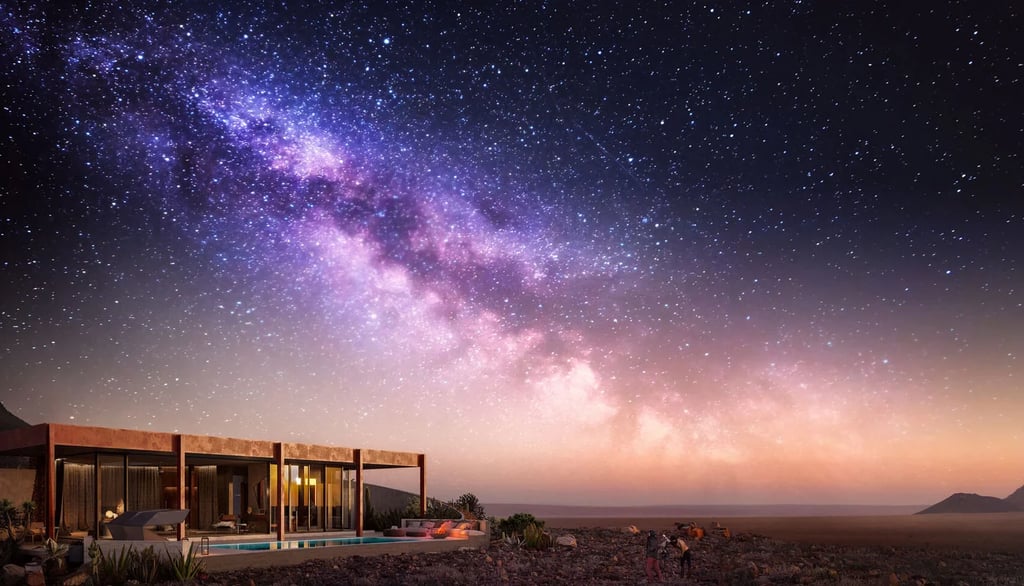
There is a moment—just after sunset in the desert—when the world disappears. No traffic. No noise. No distraction. Only the vast silence and a sky filled with stars. This is where a new kind of ultra-luxury has emerged: desert living reimagined not as survival, but as pure, curated isolation. For high-end travelers, the desert has become the ultimate stage for something rare: absolute stillness.
Once considered remote and inaccessible, deserts are now among the most sought-after luxury destinations. From the golden dunes of Dubai Desert Conservation Reserve to the cinematic landscapes of Wadi Rum, elite travelers are trading city skylines for open horizons. The appeal is simple but powerful: the desert offers something no urban destination can—space, both physical and emotional.
Behind the simplicity of canvas and sand lies an experience engineered to perfection. A $10,000 desert suite is not defined by excess, but by precision. King-size beds dressed in fine linens, private plunge pools overlooking endless dunes, outdoor bathtubs under open skies, and personalized butler service create an environment where comfort meets vastness. At properties like Al Maha, a Luxury Collection Desert Resort & Spa and Amangiri, the philosophy is clear: deliver extreme isolation without sacrificing a single element of refinement.
This is not simply a stay—it is a carefully orchestrated experience. The day unfolds slowly, guided by the rhythm of the landscape. Sunrise brings quiet reflection as the dunes shift in color. Afternoons invite exploration through private dune drives or camel treks. Evenings culminate in intimate dining under the open sky, followed by nights defined by silence so complete it becomes almost tangible.
The growing appeal of desert luxury reflects a deeper transformation in traveler psychology. Today’s affluent traveler is no longer seeking stimulation, but relief from it. Disconnection has become a premium experience. Privacy is no longer a feature—it is the product. In a hyper-connected world, the ability to step into complete stillness has become one of the most valuable forms of escape.
There is also a physiological dimension to this experience. Vast, open landscapes like deserts reduce cognitive overload and allow the mind to reset. Without visual clutter or constant input, attention sharpens and thought slows down. What begins as an aesthetic experience gradually becomes a mental recalibration.
Yet this form of luxury exists within fragile ecosystems. Desert environments demand careful balance. Water scarcity, energy consumption, and environmental impact require thoughtful design and strict conservation practices. Leading properties are increasingly adopting solar energy, low-impact architecture, and sustainable resource management, understanding that the true value of the desert lies in preserving its untouched nature.
What ultimately defines sleeping under the stars is not the suite itself, but the shift in perspective it creates. In the desert, scale changes. Time stretches. Priorities realign. You are no longer surrounded by things, but by vastness. And within that vastness, clarity emerges.
A $10,000 desert suite is not about extravagance. It is about access—to silence, to space, to a different state of mind. As luxury travel continues to evolve, experiences like these will define its future, not because they are expensive, but because they are unrepeatable. Because in the end, the greatest luxury is not what you own, but what you are able to feel.
lux Voyage Hub
A destination for those who demand the extraordinary — curating the world's finest travel experiences since 2024.
Discover
Experiences
contact@luxvoyagehub.com
+33 0763725182
© 2026. All rights reserved. nothingconcepts
Company